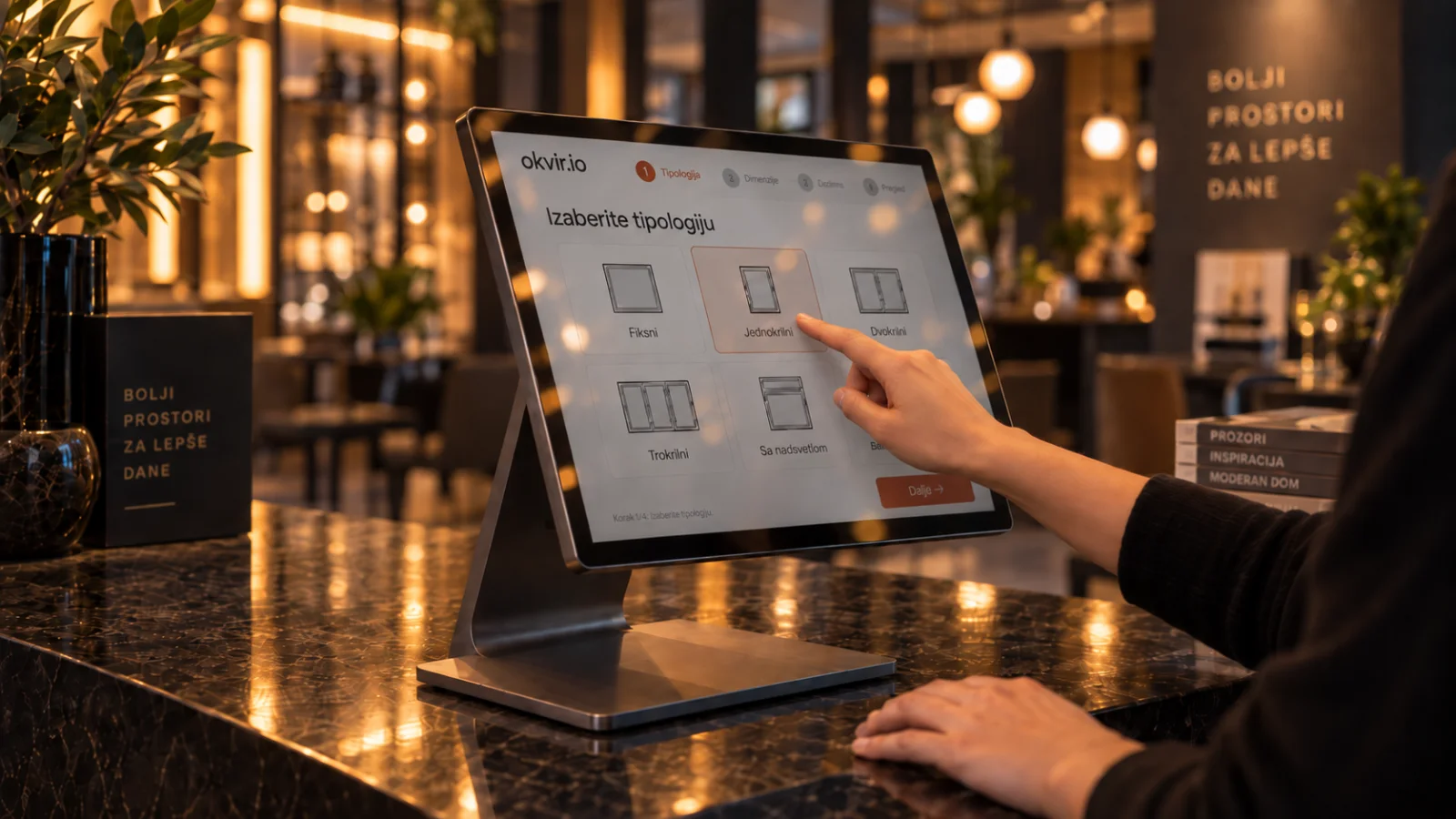
Selling and manufacturing windows and doors is not simple work — and it should not be presented as if it were. A single quotation may involve the construction type, dimensions, opening method, hardware, glazing, colour, accessories, price, discount, lead time and permitted combinations. The complexity itself is not the problem. The problem begins when every salesperson has to remember, check and resolve it manually.
That is why a simple screen is not evidence of a simple system. Very often, the opposite is true: the fewer unnecessary choices a user sees, the more carefully the system behind the process must manage the rules.
Joinery is complex, but the work does not have to feel burdensome
In the window and door industry, much depends on context. A particular dimension may be suitable for one variant but not another. The opening choice affects the hardware. Glazing, colour or an accessory may change the price, feasibility or commercial conditions. When preparing a quotation, a salesperson is therefore answering more than “what does the customer want?” They are also addressing “what can, should and makes commercial sense to offer?”
Without a well-designed system, those checks are scattered across spreadsheets, price lists, colleagues’ experience, messages and later corrections. The most experienced salesperson often becomes the living manual for the rest of the team. That can work for a while, but it is difficult to scale across more employees, sales locations, distributors or markets.
Knowledge should not disappear when the most experienced person is unavailable. It should be organised so it can support everyone involved in the process.
Bad simplicity removes the rules
When people talk about “simple software”, they often mean fewer fields, fewer buttons and fewer screens. Those things matter, but they are not enough. If a system only hides complexity by allowing every combination and leaving the user to check everything afterwards, it has not become simple. It has merely moved responsibility onto the person using it.
That kind of simplicity can look appealing at first: the user enters items quickly and receives a quote. Then the questions arrive. Is the configuration actually permitted? Is the price complete? Was the right discount applied? Can production deliver what was agreed? The more of these questions are resolved after a quote has been sent, the greater the risk of errors, lost time and uncomfortable conversations with the customer.
We do not simplify joinery. We simplify the work of handling its complexity.
Good simplicity keeps the logic in the background
A good window and door configurator does not ask users to think about every rule at once. It guides the process through relevant decisions and shows only what the user needs at that moment. Behind a simple choice may sit rules for dimensions, hardware, glazing, colours, prices, discounts and permitted combinations — yet the user does not need to open ten different documents to reach the next step.
For example, a customer may want a particular window and a particular colour. It is not useful for the salesperson to manually search through every possible variation. It is more useful to work through a clear process in which the system helps them reach options that make sense for that specific quotation. The conversation can then remain focused on the customer’s needs, rather than an administrative hunt for rules.
This does not mean the user loses control. On the contrary, good structure provides more confidence in a decision because choices are made with the right context.
The real measure of simplicity
The number of fields in a form is not the real measure of quality. Nor does the number of clicks say much on its own if the user has to consult a price list or call production after every click. What matters more is how many decisions, checks and manual steps the user no longer has to perform alone.
A useful system reduces repeated checks, keeps quotations consistent and makes cooperation easier between sales, technical preparation, production and service. For a business owner, that means a process less dependent on individual memory. For a salesperson, it means more time for the customer. For a distributor, it creates a clearer route to a correct quotation. For the end customer, it means less uncertainty and a more professional experience.
A simple process for different roles
The same technical and commercial logic does not need to be presented in the same way to everyone. A salesperson needs a fast, dependable route to a quotation. An installer needs the information required for on-site delivery. A service technician needs a clear view of the agreed configuration. A production worker needs information for their part of the job. The customer wants an understandable choice without feeling they must become a window and door expert.
That is why the quality of a digital process is not measured by how many technical details it shows to everyone. It is measured by whether each role receives enough information for the next correct action — neither too little nor too much.
Where Okvir.io adds value
Okvir.io connects a product’s technical and commercial logic with simpler day-to-day work. Rules remain in the background of the process while the salesperson, installer, service technician, production worker, distributor and end customer move through a clearer workflow.
The aim is not to hide or diminish the expertise behind windows and doors. The aim is to make that expertise available at the right moment through a process that helps people work more accurately, quickly and confidently. When the system takes on part of the complexity, the team can focus on what has the greatest impact: sound advice, an accurate quotation and reliable delivery.